Festival MURAL is already one of the best things that happens in Montreal every summer.
For about ten days, Boulevard Saint-Laurent becomes an outdoor gallery that anyone can walk through for free. Muralists from across Canada and around the world spend days painting building-scale works on the facades of the Plateau and Mile End. By the end of the festival, the neighbourhood looks completely different.
We have been part of that for a few editions now, bringing projection mapping to Festival MURAL Montreal as a way to extend the experience past sunset. One of the most significant of those collaborations was with Projet TYXNA a Montreal collective that works at the intersection of street art and digital art — on their mural Pulsar. What follows is what that actually looked like — not the polished version, but the real one.
Why Festival MURAL Montreal Is the Right Stage for Projection Mapping
Most projection mapping happens in controlled environments: a corporate event, a museum installation, a product launch. Festival MURAL is the opposite of all of that. The audience is thousands of people who happen to be walking by. The mural is painted on a real building on a real street. The timeline is set by the sun, not by a production schedule.
That unpredictability is exactly what makes projection mapping at Festival MURAL Montreal interesting and difficult. You are not controlling the viewing experience. You are setting something in motion on a public wall and seeing what happens.
What happens, in our experience, is that people stop. They pull out their phones. They stay longer than they planned to. A mural that was already good becomes something they feel compelled to share.
Projecting on Pulsar: Working with TYXNA
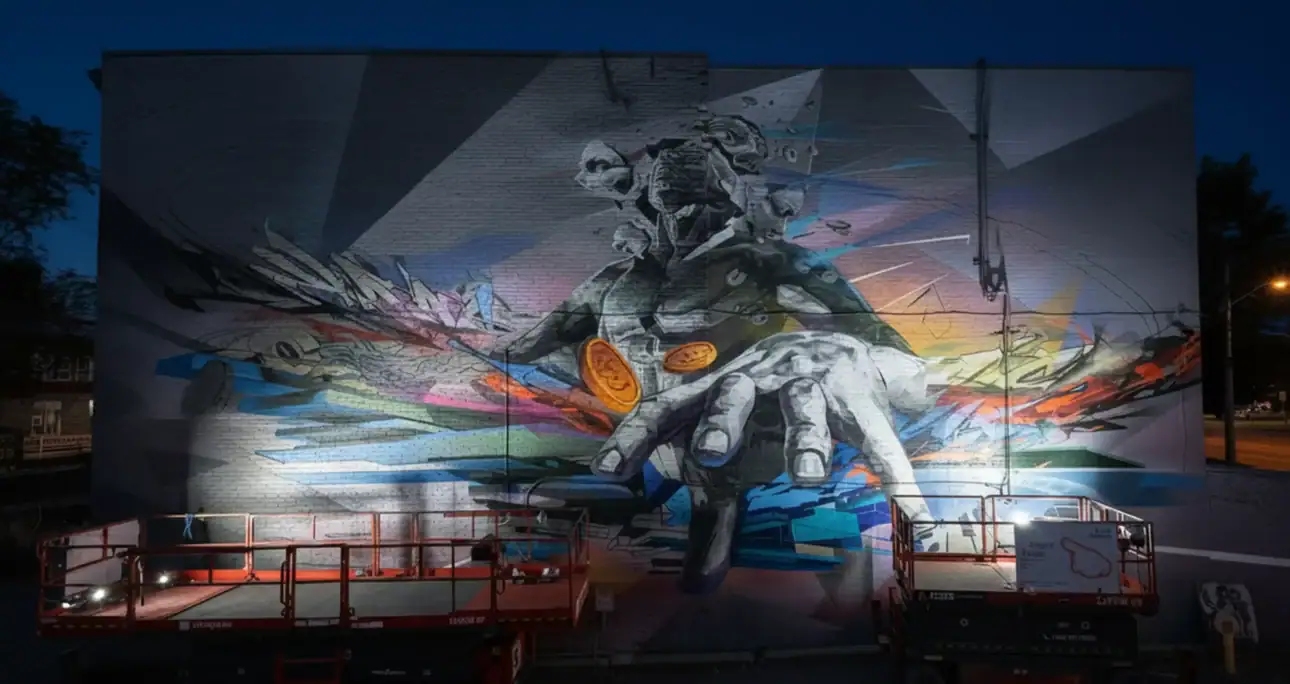
Pulsar gave us an unusually rich surface to work with. TYXNA whose members include Fuse, Zek, Dodo, and Haks painted the mural on the north facade of Moog Audio, one of the most visible walls on the festival route. The composition centres on a figure floating through space, surrounded by abstract orbiting elements, fragmented into multiple graphic styles as if mid-explosion. There are references to music woven throughout wave forms, synthesizer shapes in acknowledgment of the building itself. The whole thing reads like a vortex.
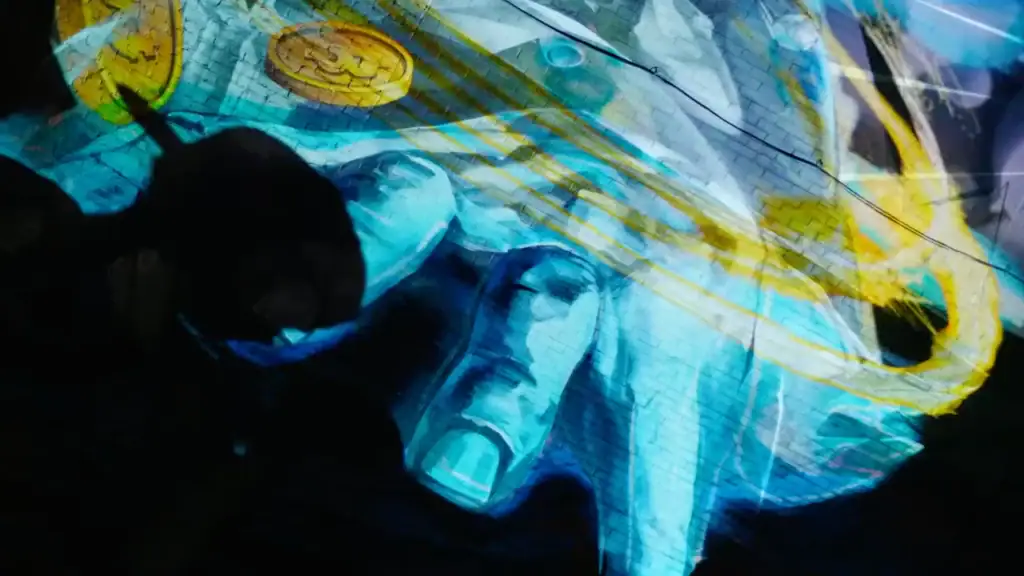
That kind of visual complexity is exactly what responds well to mapping. The composition already had depth, movement, and layers. Our job was to animate what was already there: to make the orbit feel real, to push the fragmentation further, to give the vortex somewhere to go after dark. The mural itself directed us.
What made the collaboration with TYXNA work was a shared approach to the public experience. The space around Pulsar was designed to be activated there were block parties, graffiti book signings, and gatherings that the mural anchored throughout the day. The projection shows at night were a continuation of that, not a separate event.


The Technical Challenge of Projecting on Festival Murals
Outdoor projection requires significantly more lumens than indoor work. Streetlights, ambient urban glow, and the fact that you cannot control the environment all work against you. We typically run higher-brightness projectors than we would indoors and time our shows to start after full dark — which in Montreal in June means waiting until close to 10 PM.
Setup has to happen around festival foot traffic. We cannot close Boulevard Saint-Laurent to set up equipment. We work within the flow of the event, which means our setup window is often compressed and we are calibrating while people are already walking past and asking questions.
The murals themselves are painted on textured surfaces — rough concrete, brick, stucco. The Moog Audio facade is no exception. Every surface texture affects how the projection looks, and the content has to be designed with that in mind.


What Projection Mapping Does for Street Art
The way we approach projection mapping at Festival MURAL Montreal is additive. The mural is the foundation. Our work builds on top of it. The animation responds to the existing shapes and colours rather than replacing them. When we project onto a mural, the goal is to make people look at the painted work more carefully, not less.
Some of the best moments at Festival MURAL happen when someone who walked past the mural a dozen times during the day sees it for the first time at night, under projection, and has a genuinely different experience of the same work. With Pulsar, that gap between the day version and the night version was especially wide — the floating figure that already felt in motion during the day felt like it was actually moving at night.
Montreal as a City Built for This
Montreal is an unusually good city for projection mapping street art. The building stock offers interesting surfaces — brick rowhouses, concrete lofts, industrial facades. The street art culture is serious and well-supported, which means the quality of the murals is consistently high. TYXNA is a good example of that: a collective with over 500 projects behind them, built around the idea that public art should be both immersive and accessible.
The cultural infrastructure — Festival MURAL, institutions like MU, a city government that has actively invested in public art — creates real opportunities for this kind of work. Our collaboration with TYXNA on Pulsar was possible because Montreal has built an ecosystem where it can happen.
What Comes After the Show
The projection runs for a few nights during the festival. Then the projectors go back in the van, and the mural goes back to being a mural — which is exactly as it should be. Pulsar stayed up on the side of Moog Audio on Boulevard Saint-Laurent through the rest of the season. The street art was always the main event. We just showed up for a few nights to remind people it was there.
There is a postscript to this one. As we write this, TYXNA is back on the same wall at Moog Audio — repainting it completely with a brand-new mural. Pulsar is disappearing, layer by layer, under fresh paint. That is the deal with street art: it is never meant to be permanent. A wall is a moment, not a monument. Knowing that Pulsar would eventually be painted over is part of what made projecting on it feel worth doing — you are not preserving the work, you are marking the time it was there. By the time you read this, the floating figure may already be gone, replaced by whatever the collective is putting up next. And when that new mural is finished, there is a good chance we will be back after dark to light it up too.
We documented this year’s work in a reel posted on June 6, 2026. If you want to see what projection mapping at Festival MURAL Montreal actually feels like, that is the best place to start.